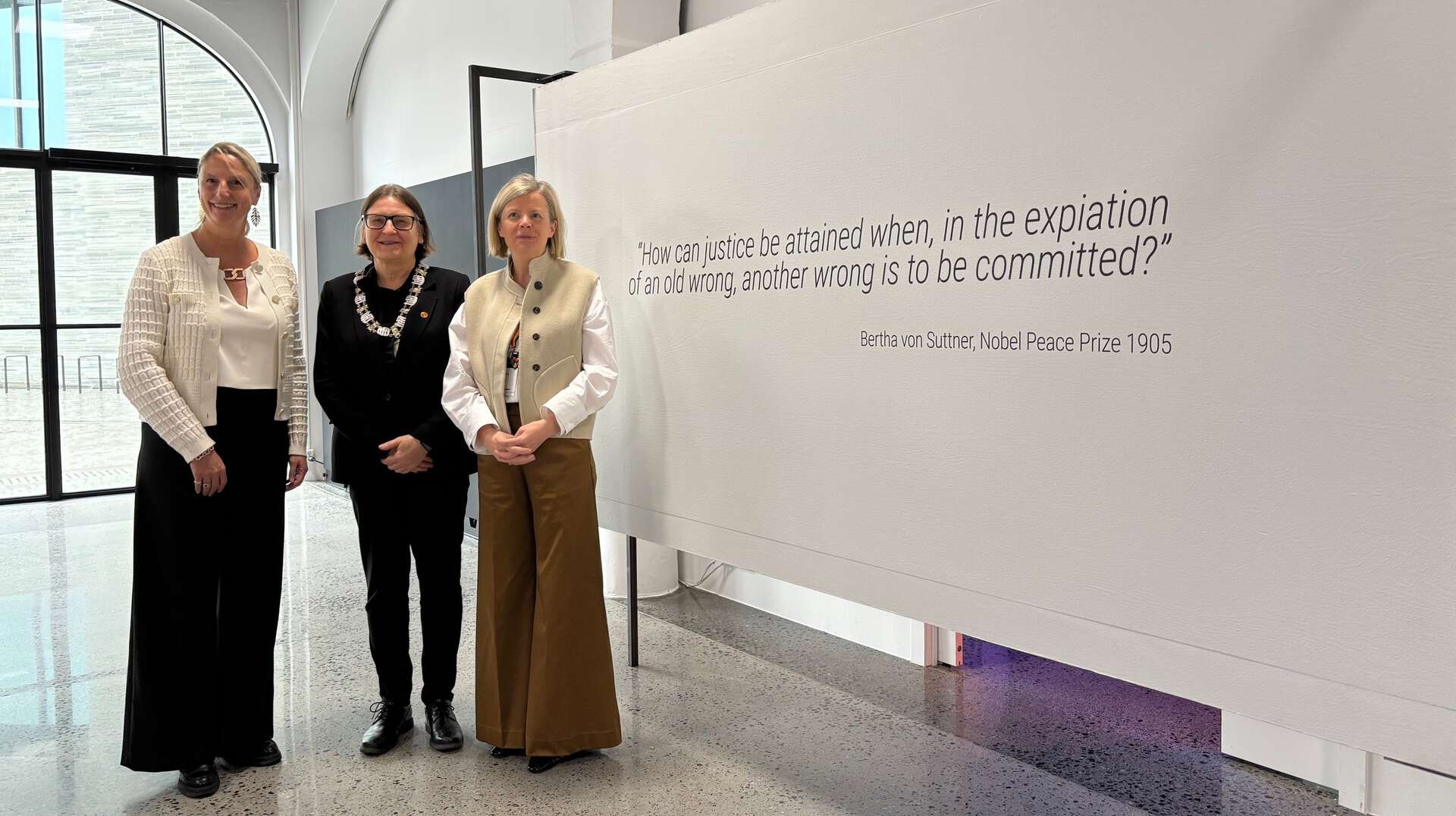
During the recent state visit from Their Majesties King Philippe and Queen Mathilde of Belgium to Norway, education and international cooperation featured prominently on the agenda. At a roundtable hosted at the Nobel Peace Center, Belgian and Norwegian partners discussed the protection of civilians and the role of education in building sustainable peace.
In his opening remarks, His Majesty King Philippe underscored the importance of education as a foundation for dignity, resilience and peace. He highlighted the role that initiatives like the Global University Academy already play, and can further strengthen, as collaborative, equitable and inclusive platforms for expanding access to higher education. The notion of dignity ran as a common thread throughout the discussion, with participants returning to the importance of ensuring that displaced people are not only protected, but also given real opportunities to rebuild their lives through education.
Rethinking how universities work together
As part of the programme, the rectors of the University of Oslo, KU Leuven and UCLouvain jointly presented the Global University Academy to the royal delegation and ministers. Highlighting the urgency of the challenge, Rector Ragnhild Hennum of the University of Oslo noted:
- With over 120 million people forcibly displaced, we cannot accept that higher education remains out of reach for most. Through the Global University Academy, we are rethinking how universities can work together to bring higher education closer to those who need it most.
Building on this, Rector Severine Vermeire of KU Leuven emphasised the importance of relevance and scale:
- Our ambition is not only to pilot one programme, but to build a model that can scale, combining academic quality with flexibility, and ensuring that what we offer is closely linked to local needs and opportunities.
From UCLouvain, Rector Françoise Smets highlighted innovation in pedagogy:
- We are developing new ways of teaching and learning through hybrid models, peer-to-peer approaches and inclusive design. That will allow students in very different contexts to learn together and succeed.
The discussion highlighted both the scale of global displacement and the urgent need for new, collaborative models of education delivery. With only a small share of refugees currently able to access higher education, the Global University Academy aims to develop flexible, accredited learning pathways that can reach learners where they are.
Education as a pathway to self-reliance
Her Majesty Queen Mathilde showed particular interest in the mental health challenges faced by refugees during and post conflict. This is an area increasingly recognised as critical for learning, wellbeing and long-term recovery, and is reflected in the Global University Academy’s academic portfolio. A new course in Mental Health and Psychosocial Support (MHPSS), developed in collaboration by the University of Oslo and the German Jordanian University is set to launch later this year.
The roundtable underscored the strong alignment between the Belgian and Norwegian Ministries of Foreign Affairs in promoting education as a pathway to dignity, resilience and self-reliance. It also demonstrated how partnerships between universities can play a concrete role in addressing some of the most pressing global challenges of our time. As an example, a new course under construction by KU Leuven, the Norwegian University of Life Sciences and Gulu University will be focusing on, and addressing challenges within Green Technology, Sustainable Agriculture and Development.