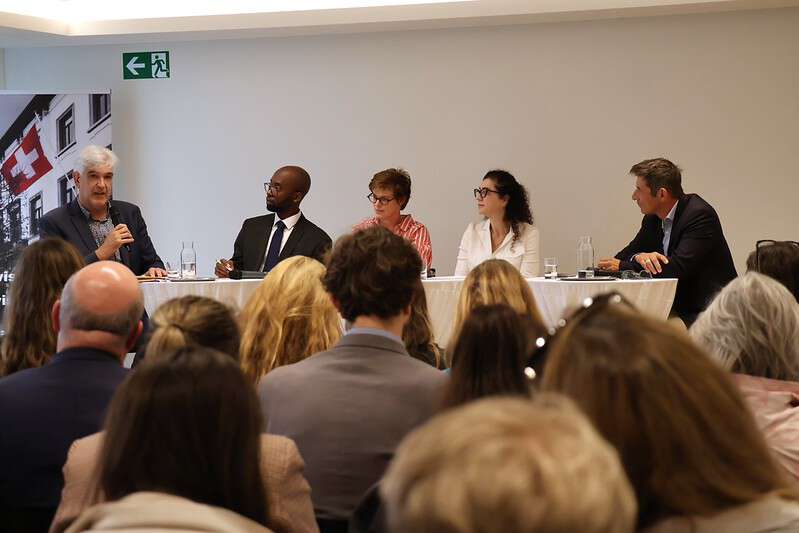
The event featured two panel debates exploring higher education as a policy lever in displacement and global development, and how to translate policy commitments into practice.

Opening the event, Swiss Ambassador to Belgium Jacques Pitteloud stressed the urgency of expanding educational opportunities for displaced youth, warning that failure to do so would have significant global consequences. Bert Versmessen, Ambassador and Deputy Permanent Representative of Belgium to the European Union, emphasised the role of universities as institutions of inclusion and solidarity.
Angela Moore, Head of Policy at UNHCR’s Representation for EU Affairs, pointed to the wide-ranging benefits of higher education, including economic growth, innovation, civic engagement, public health, and social cohesion. She underscored its importance as a pathway to self-reliance and durable solutions for refugees, and pointed to the Global University Academy as a promising model for expanding access through partnerships between international institutions and universities in refugee-hosting countries.
The dialogue also examined the European Union’s renewed approach to fragile contexts. Chiara Adamo, Acting Director for Human Development, Migration, Governance and Peace at DG INTPA, outlined their new framework that seeks to address the root causes of crises—including conflict, climate change, and economic distress—by linking humanitarian action, resilience-building, and long-term development. This emphasis on long-term approaches was echoed by Kathelijne Houben of VLIR-UOS, who noted that global academic cooperation can play a vital role in supporting scholars and students at risk, but requires new partnerships, funding mechanisms, and stronger links between academic cooperation and humanitarian responses.
Building on this emphasis on partnership and long-term approaches, Karl Blanchet, Academic Director of InZone, University of Geneva and Global University Academy Vice Chair, argued that, to reach the number of students needed to achieve transformative change, the ecosystem being built and represented by the Global University Academy offers a scalable and sustainable solution.
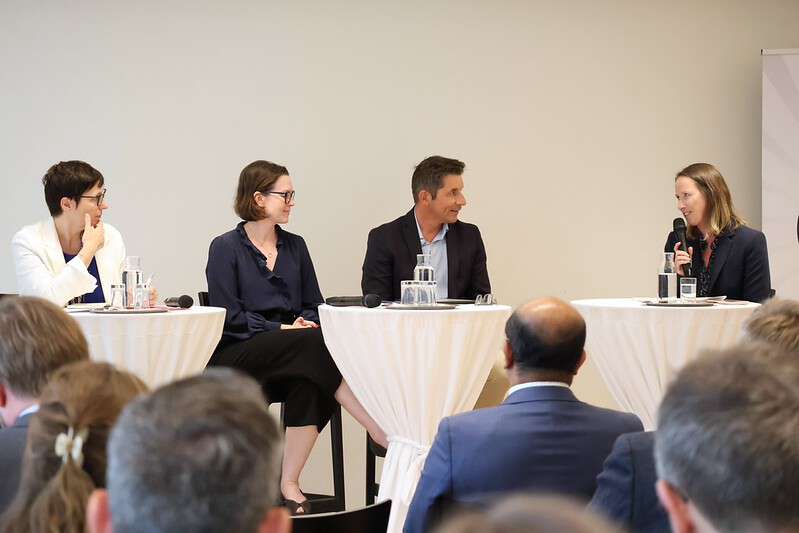
The discussion also highlighted the importance of ensuring that systems are designed to support refugee students effectively. Daniel Mutanda, a member of the Tertiary Refugee Student Network, stressed that refugee students navigate cultural systems within universities that define who belongs, whose knowledge counts, and whose decisions matter. No single intervention can address all of these challenges. Instead, progress depends on universities, policymakers, donors, and refugee students working together to identify barriers, develop solutions, and adapt their approaches over time.
Participants consistently identified education as a key driver of resilience and a critical investment in more stable and prosperous futures. Discussions also highlighted the importance of financial inclusion and stronger connections between higher education and employment opportunities for refugees.
Peter Lievens, Professor at KU Leuven, and Rachael Sears, Vice-President of Southern New Hampshire University and Executive Director of SNHU’s Global Education Movement, highlighted the success of both new and established higher education initiatives, demonstrating that higher education is one of the most effective pathways to employment and self-reliance. As evidence of this impact, Sears noted that 85% of SNHU refugee students secure employment within six months of graduating.
A recurring message throughout the event was that higher education should be recognized as a central component of refugee responses and long-term development strategies, benefiting both displaced learners and host societies.